

In its 2024 Mirror, Mirror report, The Commonwealth Fund compared health system performance in the U.S. and nine other countries (Australia, Canada, France, Germany, the Netherlands, New Zealand, Sweden, Switzerland, and the United Kingdom). One of the things they looked at is “administrative efficiency”. Administrative efficiency means how well a country handles things like paperwork, billing, and insurance claims. These tasks affect both doctors and patients, shaping how easy or frustrating it is to get care and pay for it.
What did they find? Switzerland and the U.S. did much worse than the other countries.
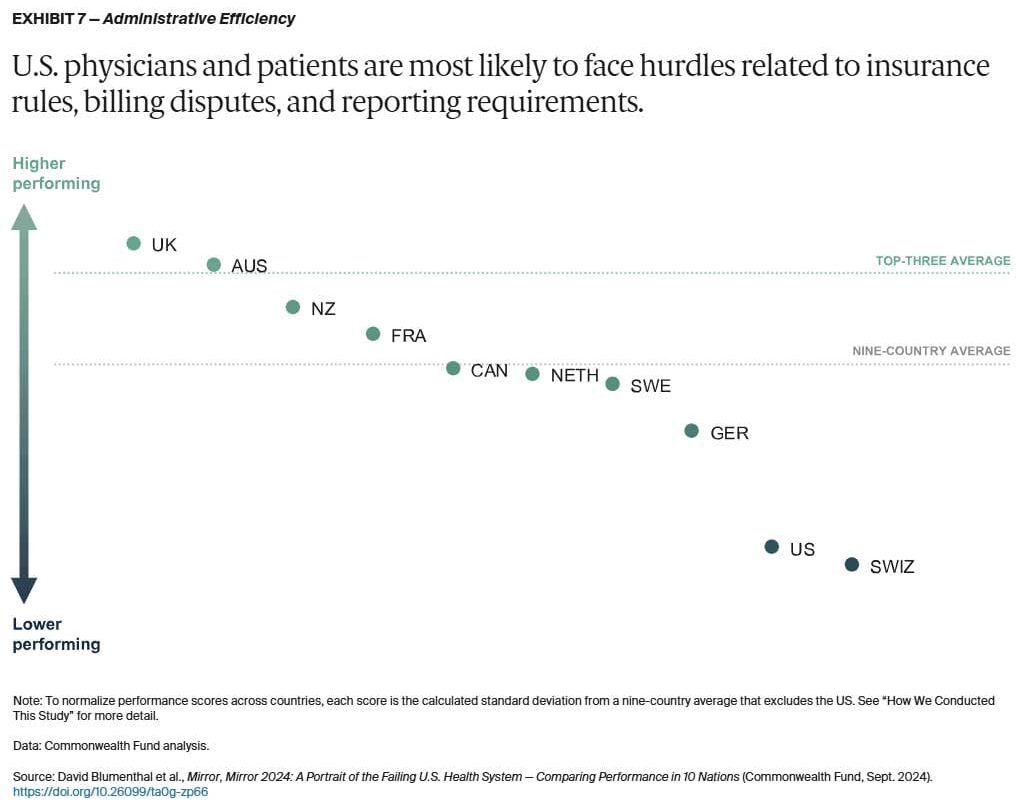
This graph shows the results. Here’s how to read it:
- Each dot is one country, labeled with abbreviations (e.g., AUS = Australia, SWIZ = Switzerland, U.S., etc.).
- The vertical axis (up/down) shows performance on administrative efficiency. A country higher up the chart is doing better.
- The horizontal lines show the average performance of the best three countries and all nine (not including the U.S.), so you can see which country is near the top, middle, or bottom.
Who Does the Best?
Australia and the United Kingdom come out on top for administrative efficiency. In these countries, billing and paying for health care is simpler and less stressful for both patients and health care providers. For example, in Australia, doctor and hospital bills are sent to government agencies and insurance companies electronically and paid instantaneously. In the United Kingdom, most health services are provided free to patients through the National Health Service (NHS), so doctors don’t have to bill patients or government agencies for each service. This cuts down on paperwork and confusion.
Who Struggles the Most?
Switzerland and the United States rank at the bottom for administrative efficiency. In the U.S., the health care system is complicated by thousands of different insurance programs and plans, each with its own rules and costs. This means doctors and their staff spend a lot of time dealing with billing, insurance approvals, and disputes over coverage. Patients also face hassles, such as sorting out medical bills and arguing with insurance companies over what will and will not be covered. This complexity creates stress, delays care, and can worsen outcomes.
Why Does This Matter?
When the administration of health care is efficient, doctors can focus more on treating patients, and patients spend less time worrying about bills and paperwork. Countries that keep administrative tasks simple also tend to have lower costs overall and happier patients and providers who enjoy better health and longer lives.
Takeaway for the U.S.
The graph above highlights a major problem in the U.S.: too much time and effort spent on paperwork and insurance issues. Making health care administration simpler could save money, reduce stress, and make the health care experience better for everyone.
Click here to learn more about universal health care coverage.