
© 2024 The Asclepius Initiative Inc. All Rights Reserved
Health care coverage helps to pay for medical care, but it does not cover every cost. Individuals and families are often responsible for a portion of their care, as well as other health-related expenses that may not be covered by insurance.
Planning for these costs is an important part of managing financial health. Health Savings Accounts (HSAs), Flexible Spending Accounts (FSAs), and Health Reimbursement Arrangements (HRAs) are designed to help with qualified medical expenses. Each works differently, but all can play a role in covering health care costs.
Qualified Medical Expenses
The IRS defines which expenses can be paid for using HSAs and FSAs. These include a wide range of medical, dental, and vision services and products for individuals, spouses, and dependents.
Qualified expenses may include copays, coinsurance, deductibles, prescription medications, and vision care such as eyeglasses or contact lenses. Many over-the-counter items are also included, such as pain relievers, bandages, pregnancy tests, and menstrual products.
Examples of Qualified Medical Expenses (as Defined by the IRS)
- Acupuncture
- Ambulance
- Artificial Limbs
- Birth Control
- Blood Sugar Test Kits for Diabetics
- Breast Pumps and Lactation Supplies
- Chiropractor
- Dental Treatments
- Doctor’s Office Visits and Copays
- Eyeglasses and Contact Lenses
- Feminine Hygiene Products
- Hearing Aids and Batteries
- Hospital Services
- Inpatient Addiction Treatment
- Insulin
- Laboratory Fees
- Mobility Assistance Devices
- Over-the-Counter Medications
- Physical Therapy
- Prescription Medications
- Psychiatric Care
- Speech Therapy
- Stop Smoking Programs
- Surgery (excluding cosmetic surgery)
- Vaccines
- Vision Exams
- Wheelchair
Click here for more information from the IRS about Qualified Medical Expenses.
Health Savings Accounts (HSAs)
An HSA is a savings account that allows money to be set aside for qualified medical expenses.
Contributions are tax-deductible, the funds grow tax-free, and withdrawals for qualified medical expenses are also tax-free.
To open and contribute to an HSA, a person must be enrolled in a high-deductible health plan (HDHP). These plans typically have lower monthly premiums but higher out-of-pocket costs.
If an HSA is offered through an employer, contributions may come from the employee, the employer, or both. Total contributions are limited each year by the IRS. For 2026, individuals can contribute up to $4,400, and the contribution limit for family coverage is $8,750. Individuals age 55 and older can contribute an additional $1,000.
One key benefit of an HSA is that the funds remain with the individual, even following termination of employment.
HSAs may also be available with certain Marketplace plans. Beginning in 2026, all Bronze and Catastrophic plans are eligible, and some Silver, Gold, and Platinum plans may also qualify if they meet HDHP requirements and are labeled as HSA-eligible.
Flexible Spending Accounts (FSAs)
Flexible Spending Accounts allow pre-tax money to be used for qualified medical expenses.
Both the employer and the employee may contribute to an FSA, typically through payroll deductions. In 2026, employees can contribute up to $3,400.
A key distinction between FSAs and HSAs is the “use it or lose it” rule. Funds that are not used by the end of the plan year are generally forfeited. Some employers allow a limited rollover or a short grace period.
Contribution limits and rollover rules may change from year to year.
Health Reimbursement Arrangements (HRAs)
Health Reimbursement Arrangements are employer-funded accounts used to cover qualified medical expenses.
HRAs are owned and funded entirely by the employer. Employees can use these funds for eligible expenses, based on rules set by the employer and applicable regulations.
In some cases, HRAs can be used to help pay for health insurance premiums. This is not allowed with HSAs or FSAs.
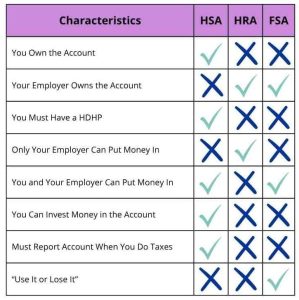
Comparing HSAs, FSAs, and HRAs
Choosing an Option
HSAs, FSAs, and HRAs each offer different features and may be available under different circumstances.
Reviewing how each option works, along with health care needs and financial priorities, can help identify the best fit.
For a more in-depth look at HSAs, FSAs, and HRAs, click here to watch our webinar.
These materials were supported by funds made available by the Kentucky Department for Public Health’s Office of Population Health from the Centers for Disease Control and Prevention, National Center for STLT Public Health Infrastructure and Workforce, under RFA-OT21-2103.
The contents of these materials are those of the authors and do not necessarily represent the official position of or endorsement by the Kentucky Department for Public Health or the Centers for Disease Control and Prevention.