
© 2024 The Asclepius Initiative Inc. All Rights Reserved
Please note: Information in this video was accurate at the time of production. Laws, policies, and program rules may have changed after publication.
Medical bills and insurance paperwork can be confusing. It has been reported that up to 80% of medical bills contain mistakes. This means individuals may be paying more than they should, or for services they did not receive.
Medical bills can be reviewed by comparing details from a medical visit with insurance carrier documents, such as the Explanation of Benefits (EOB) and the Summary of Benefits and Coverage (SBC). Reviewing these documents together can help ensure that only the correct amount is paid.
The video above demonstrates this process in practice.
Before getting started, it is helpful to gather medical bills, the EOB for the claim in question, and the SBC.
Understanding the Explanation of Benefits (EOB)
The Explanation of Benefits, or EOB, is a statement from an insurance company that shows how a claim was processed. It may be mailed or available through an online portal. Even though it is labeled “Not a Bill,” it plays an important role.
The EOB outlines what services were rendered, how much those services cost, what the insurance plan allows, and what portion the patient is responsible for paying.
It also shows how much the insurance company paid and how much is written off, the difference between what the provider charges and the amount that the provider has agreed to accept as payment in full for the particular service.
Reviewing Personal Information
The first step when reviewing an EOB is to confirm that the identifying information is correct. This includes the patient’s name, insurance plan, listed provider, and date of service. This is especially important when there has been a recent change in coverage, such as at the beginning of a new year.
Decoding EOB Codes
EOBs may show Current Procedural Terminology (CPT) codes, which are used to identify the services provided. If these codes are not explained in plain language, they can be looked up online to determine their meaning.
Comparing Charges
Medical bills should always be compared with the EOB. Dates of service, types of care, and costs should match.
It is important to make sure that all listed services were actually received and that the assigned charges align with what was expected based on the rules of the SBC.
Understanding the Summary of Benefits and Coverage (SBC)
The Summary of Benefits and Coverage, or SBC, provides an overview of what a health plan covers and how costs are shared. Insurance companies are required to provide this information.
This document explains key cost details such as deductibles, copays, and coinsurance, which services are covered, and may also list types of services that are NOT covered.
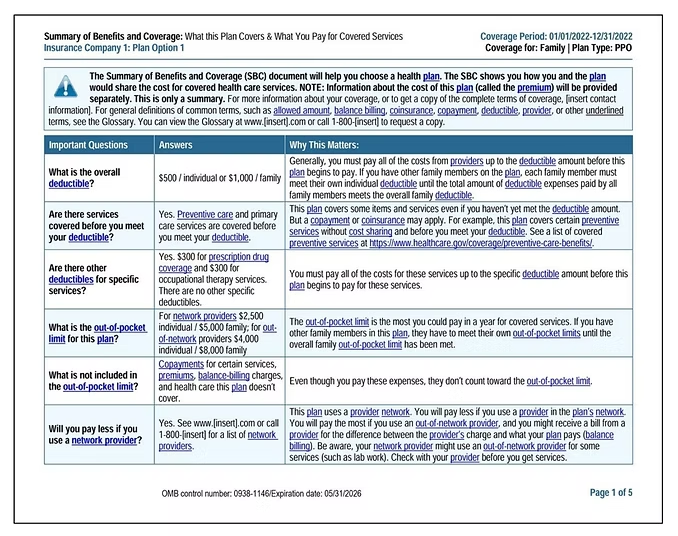
The SBC does not include premium costs and is only a summary. For more detailed information, review the Certificate of Insurance or Evidence of Coverage (EOC). If there are differences between these documents, the EOC is considered the final source.
Determining What Should Be Paid
Using information from the SBC and the allowable amount shown on the EOB, it is possible to determine the patient’s costs should be for a particular service. It is also important to compare what happened during the visit with what appears on the documents to ensure accuracy.
If something does not seem correct, ask questions.
If something is unclear or a mistake is found, contact the insurance company, the provider/facility, or both, depending on the source of the error.
Tips for Staying Organized
Reviewing medical bills alongside the EOB and SBC can help prevent overpayment.
Health care costs can be significant, and even small errors can add up over time. Taking the time to review these documents can support financial health.
For a more in-depth look at how to use your insurance documents to check medical bills for errors, click here to watch our webinar.These materials were supported by funds made available by the Kentucky Department for Public Health’s Office of Population Health from the Centers for Disease Control and Prevention, National Center for STLT Public Health Infrastructure and Workforce, under RFA-OT21-2103.
The contents of these materials are those of the authors and do not necessarily represent the official position of or endorsement by the Kentucky Department for Public Health or the Centers for Disease Control and Prevention.