

This is the second brief in our series on U.S. health care compared with 19 other wealthy nations. If you missed the first one, you can find it here. Researchers at the Commonwealth Fund compared the U.S. health care system to 19 other wealthy nations belonging to the Organisation for Economic Co-Operation and Development (OECD). Their findings for 2024 are summarized in the U.S. Health Care from a Global Perspective report.
This installment looks at affordability: how much these countries spend on health care (paid for with taxes), and how much patients must pay directly (“out-of-pocket cost”).
The short version: the U.S. spends much more on health care than any other country in the study, yet still leaves many Americans exposed to high costs.
Total Health Spending: The U.S. Outspends Everyone
For more than 40 years, health care spending has grown faster than the overall economy in every country studied. New medical technology, rising prices, and greater demand for services are all driving up costs. During that time, the U.S. spent more than any of the other 19 countries. In 2024, the U.S. spent 18% of its gross domestic product (GDP, a common measure of economic activity) on health care, nearly twice the average for OECD countries.
The chart below shows health spending as a percentage of GDP for the U.S. and the other countries in the study.
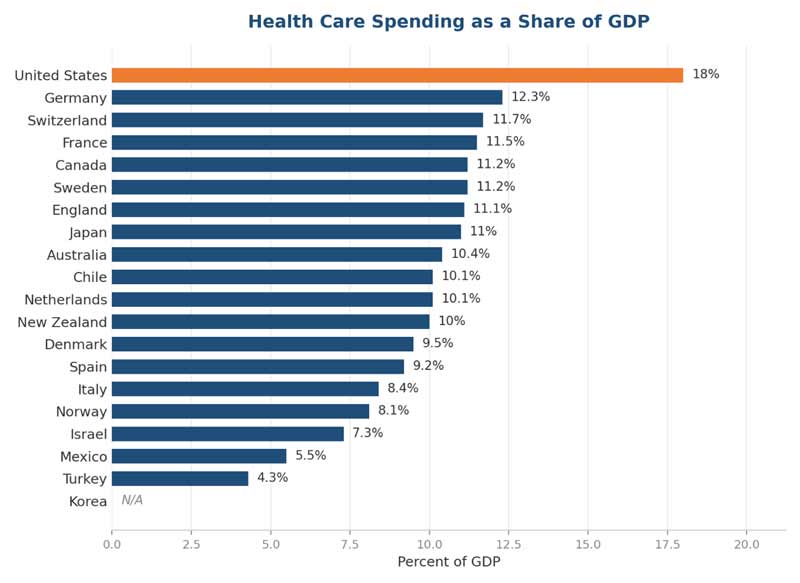
The U.S. spends much more on health care than these other countries.
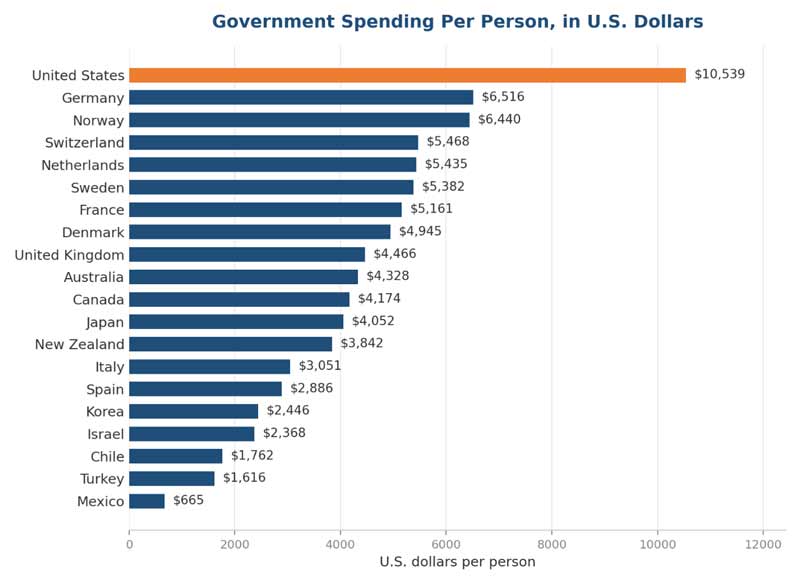
The chart below shows U.S. government health care spending in dollars per person compared with the other countries. U.S. spending was almost 50% more than Germany, the next-highest-spending country, and 15 times higher than Mexico. U.S. Government spending includes Medicaid, Medicare, State Children’s Health Insurance Programs, disability, and military plans.
Out-of-Pocket Costs
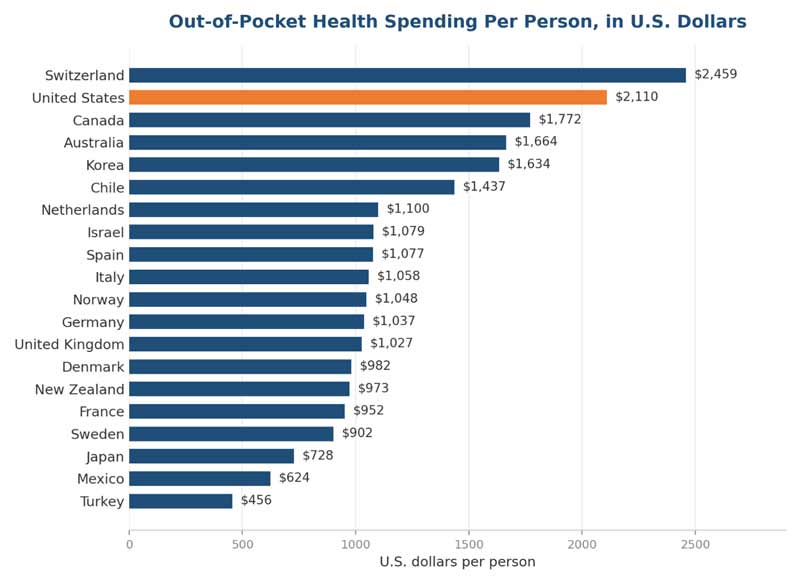
Even with the high levels of government spending per person shown above (paid for with tax dollars), Americans face the second-highest out-of-pocket costs for health services of any country in this study. People in Switzerland pay a little more, but their government spends $ 5,468 per person, while the U.S. government spends $10,539 per person. The chart below shows this.
More Americans Skip Care Due to the High Cost
As a result, Americans are much more likely than people in other countries to avoid needed care because of cost. As the charts below show, they skip prescriptions, diagnostic tests, treatment, or follow-up care more often than people in other countries.
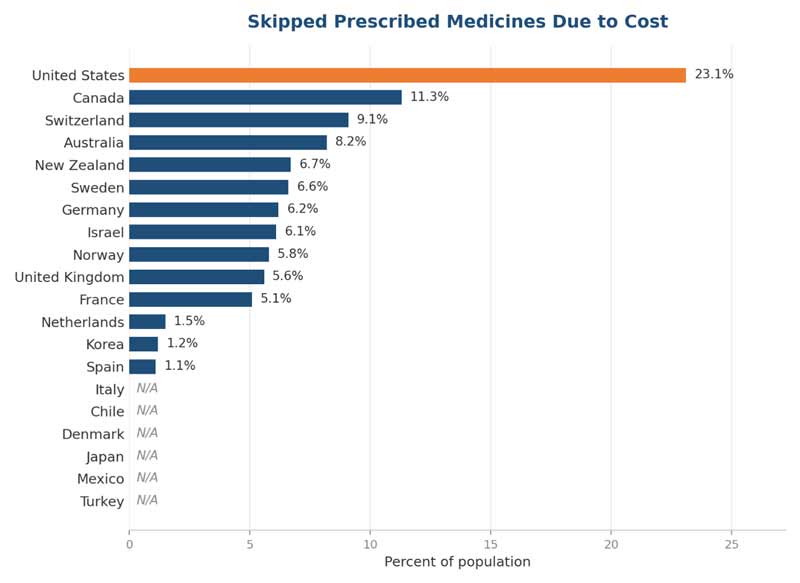
Nearly one in four Americans skipped a prescribed medicine because of cost.
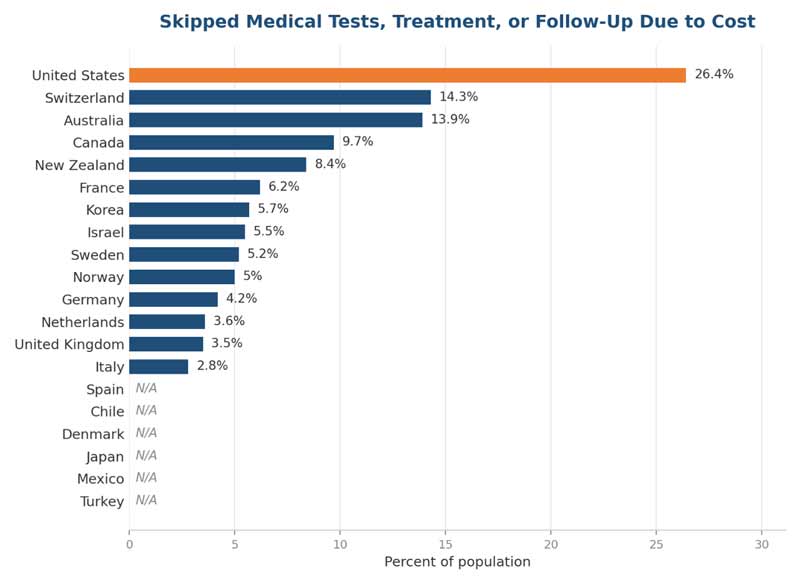
More than a quarter of Americans skipped a medical test, treatment, or follow-up because of cost.
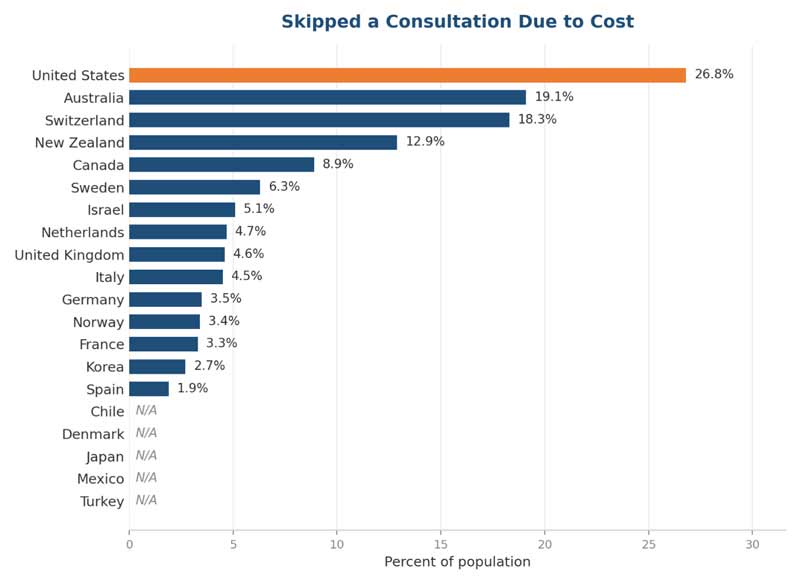
More than a quarter of Americans skipped seeing a doctor because of cost.
How Do Other Countries Control Costs?
Many other high-income countries have found ways to control health spending even though their costs are increasing. Spain provides universal coverage and spends much less on health care than the U.S. It has some of the best outcomes in the world, including high life expectancy and a low rate of avoidable deaths. Its decentralized system lets regional governments manage planning, budgeting, and purchasing within set funding limits, matching spending with local needs.
Denmark also provides universal coverage and takes a similar approach, setting overall spending budgets for regions and municipalities. It also encourages shifting care from hospitals to outpatient settings, uses value-based payment models that reward patient health rather than the volume of services provided, and promotes integrated care that brings primary care providers, specialists, and hospitals together. These strategies reduce fragmentation, limit duplicated services, and help control costs without sacrificing quality.
Are We Getting What We Pay for?
The U.S. spends much more on health care than any of the 19 other countries in this study, yet Americans still pay some of the highest out-of-pocket costs for care and medications. Are we healthier than people in these other countries? No. Do we live longer? No. Do we have better access to care? No. Other countries, all of which provide universal coverage (except Mexico, which will start in 2027), have shown that it is possible to control health care spending without sacrificing quality of care. Future briefs in this series will look more closely at these topics and explore how other countries manage to spend less while delivering better results.