

A new report from the Urban Institute shows what many people already know from experience: health care costs too much.
In the Urban Institute’s Well-Being and Basic Needs Survey, nearly half of working-age adults said their families had trouble affording health care in 2025. That included people who had problems paying medical bills, skipped needed care because of cost, or had medical debt.
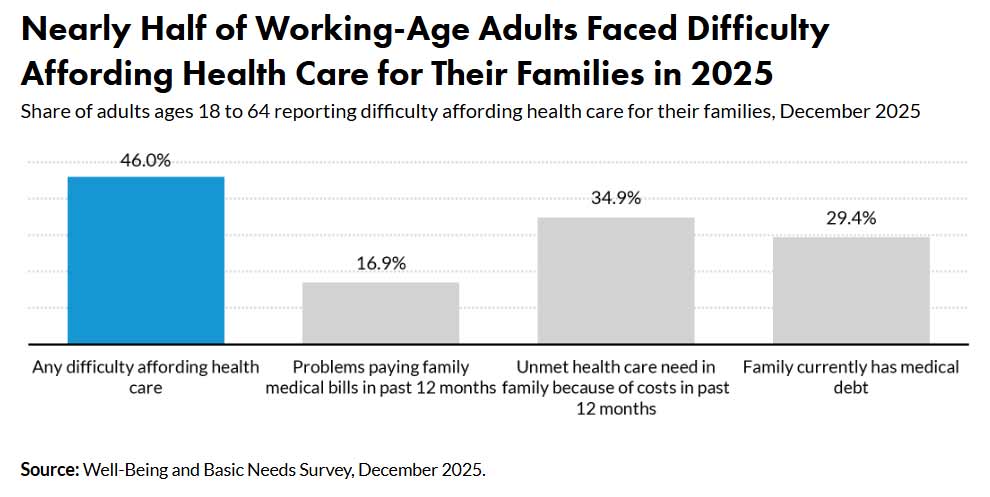
For too many, even being insured is not enough to make health care affordable.
What the Report Shows About Working-Age Adults
People without insurance were the most likely to report problems affording health care. But many people with coverage also struggled.
According to the Urban Institute, 39% of adults with employer-sponsored coverage said their families had trouble affording care. So did more than half of adults with Marketplace or other individual coverage and nearly 60% of adults with Medicaid.
This matters because health care coverage is supposed to make it easier for people to get care when they need it. But high premiums, deductibles, copays, coinsurance, denied claims, and uncovered services can still leave families with costs they cannot afford. And limited networks can make it hard to find providers who participate in their plan.
For many people, the problem is not just having coverage. The problem is being able to use that coverage without taking on debt, skipping care or medications, or giving up other basic needs.
TAI’s research in Kentucky mirrors these findings. In TAI’s 2024 survey of 1,001 Kentucky adults, 57% of insured respondents said they had delayed or skipped care or medications because of cost. Among uninsured people, that number rose to 87%.
These findings show that health care costs are a major barrier to care. They affect whether people go to the doctor, fill a prescription, follow up on symptoms, or manage a chronic condition.
Coverage Does Not Always Mean Care Is Affordable
TAI also heard this directly from Kentuckians in a 2025 study that interviewed insured adults from across the Commonwealth. Participants described long appointment wait times, high out-of-pocket costs, confusing coverage rules, travel barriers, and trouble finding providers who accepted their insurance. Having coverage helped. But it did not always make care accessible or affordable to use.
This is one of the biggest problems with the health care system in the United States. Coverage is often connected to where someone works, how much they earn, where they live, their age, or whether they qualify for a specific program. Even then, each type of coverage has its own rules, costs, networks, and limits. Common life circumstances such as job loss, divorce, and moving can result in loss of coverage. You must “pay to play,” and the costs can be prohibitive.
The result leaves many people trying to navigate a system that is expensive, confusing, and unstable.
Some Families Face Even Greater Barriers
The Urban Institute report found that affordability problems were not experienced in the same way by everyone. Adults in fair or poor health, with disabilities, with chronic conditions, and with low incomes were more likely to report trouble affording care.
That is especially concerning because people with ongoing health needs often need care more often. When costs get in the way, they may delay treatment, skip medications, or avoid follow-up care. Over time, that can make health problems worse (not good for the person) and lead to higher costs (not good for the budget).
The report also found that adults living in the South and in rural areas were more likely to report problems with affording health care. That is important for Kentucky, where many residents already face provider shortages, long travel times, and higher rates of chronic illness.
Health care costs create stress and risk across the system, which is especially problematic for people who already face barriers to care.
The Problem Could Get Worse
Policy changes to the Marketplace and Medicaid through House Bill 1, also known as the “One Big Beautiful Bill Act” (OBBBA), are expected to increase the number of uninsured people and make coverage harder to keep. Many people with coverage through the Marketplace have been affected by steep premium increases. Based on recently released figures from the Department of Health and Human Services, KFF reports that Marketplace enrollment has already fallen by three million people between 2025 and February 2026.
Employer-sponsored coverage is also becoming more expensive for many workers and families. When employers shift more costs to employees through higher deductibles, coinsurance, or premiums, people may technically have coverage but still be unable to afford care.
That is why the affordability of health care must be part of any serious conversation about coverage. It is not enough for people to have an insurance card. Coverage must be affordable, continuous, and usable.
Health Care Should Be a Right, Not a Luxury
TAI works to help people better understand the health care system we have today. Education matters because people need clear information about coverage, costs, how to read and interpret medical bills and insurance documents, and their options when coverage changes. But education alone cannot fix a system that leaves so many people unable to afford needed care.
A better health care system could guarantee affordable, high-quality, continuous coverage for everyone from birth until death, regardless of employment, income, ZIP code, or life circumstances. This is not an unattainable fantasy. Other wealthy countries provide health care coverage for everyone. The U.S. is different. It does not guarantee coverage for all people. While spending far more money per person, the U.S. has worse health outcomes than many similar countries. Americans have shorter life expectancy, more chronic illnesses, and higher maternal and infant death rates.
Health care should help people get care, not force them to choose between care, debt, and other basic needs. We deserve better.